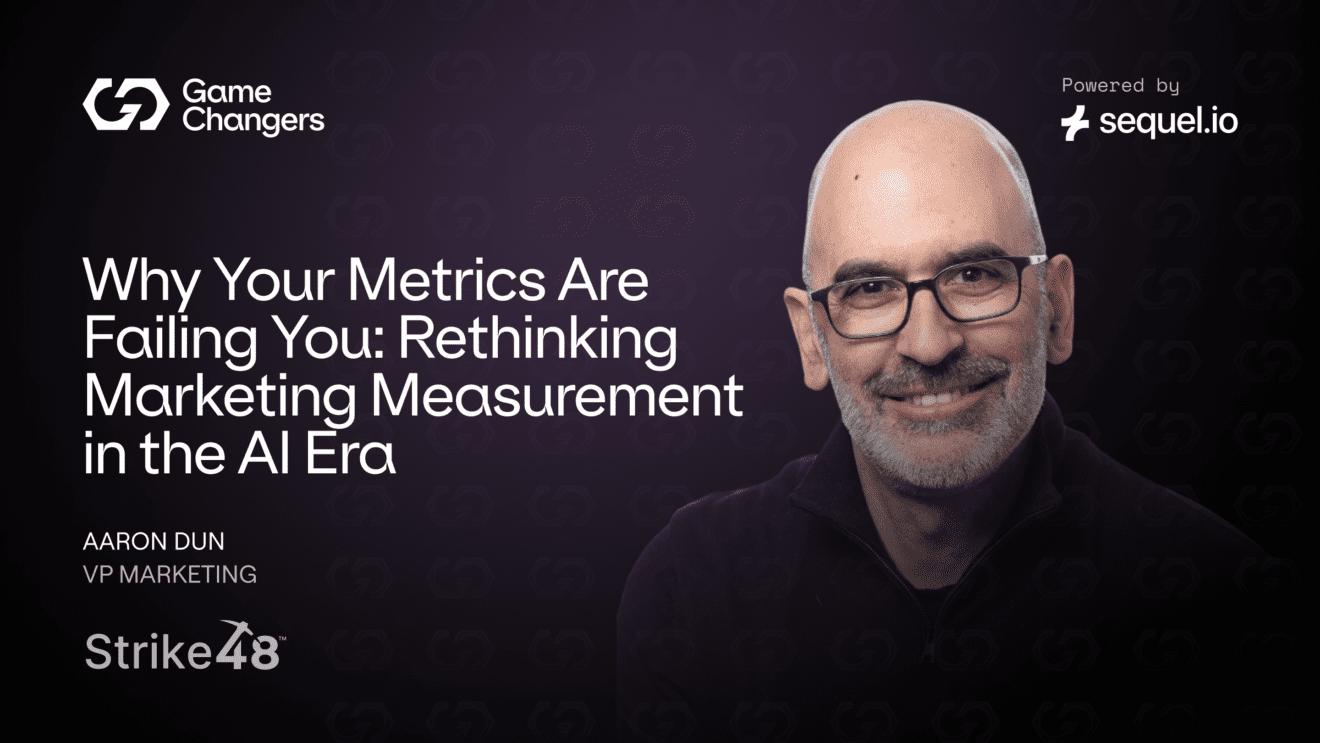
Why Your Metrics Are Failing You: Rethinking Marketing Measurement in the AI Era
Traditional marketing metrics, MQLs, attribution models, and funnel conversion rates, are no longer keeping up with how buyers actually make decisions.
In this session, Aaron Dun, VP Marketing at Strike48, shares a candid perspective on why the measurement model itself is broken, how AI is accelerating that shift, and what CMOs should focus on instead.
We’ll cover the rise of the dark funnel, the limitations of attribution, how discovery is moving off-platform, and why revenue, not activity, should be the north star. Expect strong opinions, real examples, and practical ways to rethink your GTM strategy for 2026 and beyond.

Marketing at AI Speed: Why the Old Funnel, MQLs, and Attribution Models Are Breaking
AI isn’t just another new marketing motion, it’s compressing timelines, reshaping how buyers discover products, and exposing the limits of long-standing measurement systems. In this webinar, Kathleen Booth and Aaron Dun, VP of Marketing at Strike48, focus less on hype and more on what CMOs need to change now: how teams plan, what they measure, and how they communicate impact to the business.
AI is a foundational reset, not a tactical add-on
Booth and Dun draw a line between past shifts (inbound, ABM, growth) and the current moment. Those earlier “eras” largely formalized practices good teams already used. AI, by contrast, is forcing changes to the underlying marketing operating system, because the pace of change itself has become the defining constraint.
As Dun puts it, it’s not a minor adjustment:
This isn’t just… a 25 degree tweak… This is… the opportunity really to reshape the foundation…
The implication: advantage comes from adaptability, building systems that learn and reconfigure quickly, more than from perfect upfront planning.
Strategy horizons are shrinking: plan in weeks, execute in days
A recurring theme is speed as a capability. Dun describes moving away from quarter-based execution and toward weekly planning with rapid shipping cycles. AI tools reduce the time-cost of creating v1 assets—enabling more experiments, more iterations, and faster learning.
His benchmark for the new cadence is direct:
We need to be planning weeks and executing in days.
For marketing leaders, the management challenge becomes less “how do we produce?” and more “how do we prioritize, validate, and iterate without drowning in half-finished work?”
The ceiling on scale is rising—but only if your system can keep up
Booth points to how growth expectations have escalated. Dun expands on what that means: AI increases the set of outcomes that are *possible* for smaller teams, but it also increases competitive pressure because other teams can move just as fast.
Dun’s point is less “AI guarantees growth” and more “AI changes the math of what’s feasible”:
The scale of what’s possible is dramatically different.
In practice, this pushes marketing toward repeatable distribution advantages (channels, audience, community, partners, product loops) rather than one-off campaign wins.
MQLs are increasingly disconnected from modern buying behavior
Dun makes a nuanced argument: MQLs weren’t invented to be evil, they emerged to help marketing justify spend and bring rigor. The problem is that buyer behavior has shifted. Content engagement is easier to generate, harder to interpret, and often signals interest rather than purchase intent.
One line that captures the issue:
If they engage with your content… it doesn’t mean they’re in the market.
The net effect is predictable: sales teams don’t want more “qualified” leads defined by activity, they want people who are genuinely ready to buy. This widens the gap between marketing-reported success (MQL volume) and revenue reality.
Attribution often becomes internal politics, not operational truth
The webinar also challenges a sacred cow: attribution as the master answer key. Dun describes “attribution wars” as costly and distracting, especially when teams spend hours debating which touch “gets credit” rather than improving what actually drives demand.
His summary is memorable:
Attribution wars are brutal.
The deeper issue isn’t that measurement is unimportant; it’s that many attribution practices are optimized for explaining outcomes (or allocating credit) rather than improving outcomes. When that happens, teams can “win” the reporting game while the business loses.
A better accountability model: revenue outcomes + portfolio ROI thinking
Dun advocates for a clearer separation between (a) how marketing learns internally and (b) how the business holds marketing accountable.
– Internally, marketing should absolutely measure channel performance, creative effectiveness, and efficiency—because that’s how you improve.
– Externally, leadership should care most about revenue outcomes (with pipeline as a practical proxy), not forcing every dollar into a neat attribution story.
His “holy grail” framing:
The business should not care how I get there.
This is essentially a portfolio approach: leadership funds an outcome, marketing allocates across bets, and the team is held accountable to results, not to a predetermined mix of tactics.
The website is becoming less of a discovery engine as search behavior shifts
One of the most forward-looking points is about where discovery happens now. Dun argues that people are increasingly getting answers “at the edge”, in AI interfaces, communities, dark social, and peer networks—reducing the reliability of website traffic as a primary health metric.
He poses the uncomfortable scenario many teams will face:
Website traffic is down 50%… but business is up. What do you want me to do with that information?
Booth complements this by implying the website’s job evolves: less “teach everything,” more “validate, differentiate, and convert”, through interactive experiences, proof, and clear positioning.
Running a modern marketing team: embrace chaos, impose intention
Dun is candid that the day-to-day reality of AI-speed marketing can feel chaotic. The antidote isn’t heavier process, it’s lightweight structure that forces prioritization and follow-through. He describes a weekly intention-setting rhythm so the team remains coordinated while still moving fast.
His blunt assessment:
First, I’m gonna say it’s absolute chaos.
A key operational takeaway: AI makes it easy to ship endless v1 work. High-performing teams build the discipline to identify what’s working and invest in v2 and v3—turning quick experiments into compounding assets.
Closing thought: reset leadership expectations before you get trapped by bad metrics
Across all these themes is a leadership lesson: if marketing doesn’t proactively redefine success, it will be defined by legacy proxies, MQL volume, last-touch attribution, and traffic charts that no longer reflect how buyers decide.
Dun offers a practical way to re-anchor the conversation with executives:
Tell me about the last piece of software you bought. How did you learn about it?
It’s a simple question that cuts through dashboards and returns the discussion to reality: modern buying journeys are messy, multi-source, and increasingly invisible to traditional tracking. Marketing’s job is to create credible demand and enable decisions, then be accountable to revenue outcomes, not vanity indicators.